They Lay Where They Fell
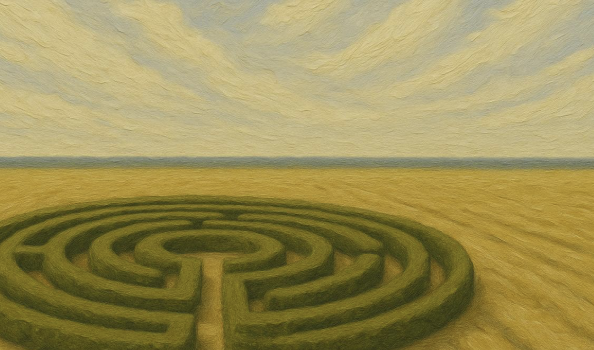
It proved so strange to me on first sight that at the next Service Centre I couldn’t help but loop around to return the way we had come, so as to pull over this time beside the scorched shell of it. This was where the maze was. Or had been, once.
‘What are you doing?’
‘I’m doubling back. It won’t take long.’
‘What for? We have hours to go.’ You were exasperated and urgent. None of this made sense to you. The trip had been less than it might have been, and you were clearly tired.
‘I saw something.’
‘But we have hours to go’, you said again.
‘You have to see this, I think.’
Though, of course, I was not certain. Not at all certain of what I had seen.
Much of what you see from a car is slow-scroll cinematography. Powerlines unspooling to the horizon. Moving arrangement of Car, House, Shed. A break of pines changing shape like an evergreen Tetris. In one place I know, before the highway splits, voluptuous folds of hills change sex as you draw near. This last film is Avant-Garde.
But close to the car is still-shot photography: the storm-struck tree. A body of water, fringed by reeds. The head turned in a flash makes a cover of a farm-gate: Gate Agape by Blue Agapanthus. Once, a single file of sheep crossed the same bridge over the creek where my English teacher and her husband lost traction on the old highway – so that she taught every class afterwards seated and came and went painfully on a stick. The sheep were lined up for shearing or slaughter. Who could tell? You are gone already. Gone into the cinema, again.
But here was the driveway of the maze. Or what had been, once. The self-same driveway of memory. So I took the exit-ramp at the Service Centre, dropping speed all the way up the incline to the overpass.
A descending climb
A lyric went through my head. I stopped the car for a moment at the Give Way line, confused.
My feet can’t make the hill
To the top of your heart
‘What did you see?’
‘I saw a car.’
‘Revolutionary’, you say.
‘It was at the maze’, I say.
‘Is that thing even still open?’
‘No. I don’t think so.’
‘So why are we going back?’
But first the overpass presented me with a puzzle.
The teardrop loops on the engineer’s design fall effortlessly from the north, but from the south the entrance is unnecessarily abrupt. The overpass asks for a sharp right turn, which I make, then veers to the left towards the Service Centre, where a roundabout is presented to the unsuspecting driver. You hope to loop around and return the way you have come, backwards.
‘Can you stop at the shop? I could use a drink’, you say.
‘You have tea.’
‘It’s cold’, you say, but I have already passed the Service Centre exit, hands at a now-awkward angle on the wheel.
‘Do you want me to go right around?’
‘No. I’ll drink the tea.’
‘I can’t tell where to get off.’
‘That one!’, you cry, and my hands obey so that we find ourselves passing some stockyards and the beginnings of a new housing estate. The land here is shaved straight to its’ skin by a yellow grader that sits motionless.
‘This isn’t the way at all. I’ve made a mistake’, I say.
You kindly refrain from saying anything.
After all this, it was a short trip back to where we had come from.
We approached the scene, at last, and I could see the Glass Art Gallery grounds over to the left. This farm and its’ outbuildings which had been transformed by some artist, or benefactor, into a fantasy landscape.
Poplars stood upright above the buildings with their paint-brush tops, and beeches flashed silver-grey-yellow from what we knew was the space around the dam. We had walked these grounds with our children, once. The stone path beneath the poplars that led to a half-tumbled stile that called for crossing. The violets that grew among the green stone at its’ base. The path up the hill to the dam.
‘Don’t go near the edge, you would say’, where the dirt dropped down sharply and the clods ran loosely away into the water if you nudged them with your toe.
‘Don’t go so close’, I would echo to the kids.
Then there was the Glass Art Gallery, with its’ fantastically fragile wares. If we were lucky, the gallery cafe was empty and the kids wandered around the grand piano that sat in the middle of the gallery.
Outside, a verandah dripped wisteria so that you could suck in your breath and see country magazine spreads every way you turn, and all the way to the creek, which trickled from the dam into the greenest of ponds and, if you were still for long enough, frog-song….
opening of ‘They Lay Where They Fell’
The Money Changers
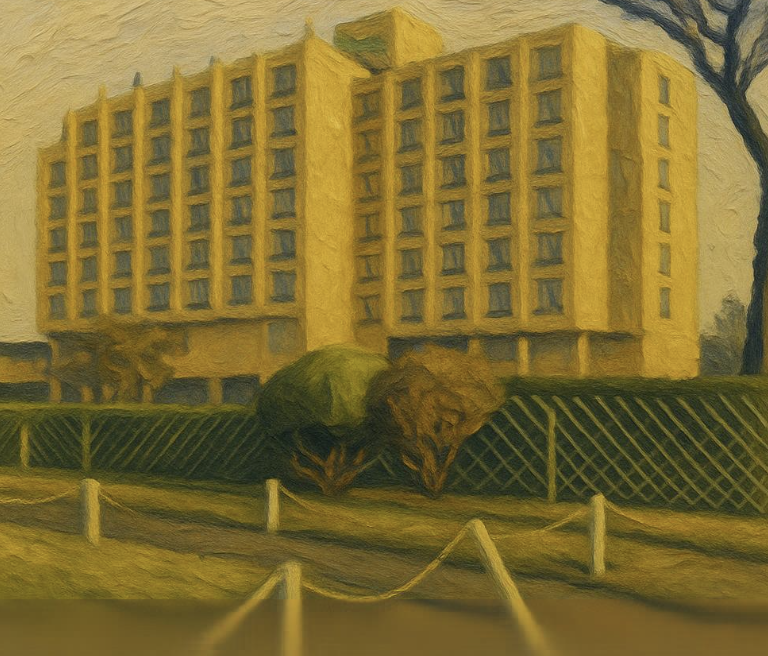
On the corner of Union & Fifth, Grace, Dolphin and Lazy keep accounts. They sit around a concrete table in the shade of the jacaranda, under the greater shade of the Holiday Inn. The Holiday inn fills the block between Union Street and Samora Michel Avenue, just where it intersects Fifth. North-South streets hold the numbers, East-West carry the politics.
The concrete table sits atop a sea of shockingly well-kept, very green, green grass. Calls come in and cars pull up. Grace gets up with a small pocketbook and a thick pile of bond notes in her hand. She leaves the concrete for the grass and the grass for the street and meets the arriving cars. Dolphin and Lazy stay at the table. Lazy, by name, should not get up for anything. Dolphin, by rights, should not be found in this most land-locked of countries, far from any ocean. I too am far from my ocean, where dolphins regularly surface in the swell around me and sometimes carve a tunnel underneath my board. I know the feel of their coming, their power and heft, the lazy speed and terrible grace.
‘Why are you called Dolphin?’ I’m seeking an exchange for the $300 USD in my hand. Grace is happy to receive it. It’s added to the thick pile which emerges from beneath her jacket. She holds the giant wad of notes in the open as she adds my tiny deposit to it. She seems unmoved by any danger.
‘My parents had a TV’, Dolphin replies. ‘They had seen a dolphin once, when not so many had TV’s. It was not like it is now with YouTube. Do you not think it a good name?’
I reply that I think it is a very good name. And I feel them coming again, with surprising speed and terrible grace.
I have a long, hot drive to Gweru ahead of me. I plan to eat well when I arrive. I’ll need a good feed, but in Gweru, they will not give me change in USD. No-one is giving USD, or has any to give. Whatever they have is stashed behind bricks in the wall and in mattresses on beds. Sealed in tins dug into the ground under fruit trees, where the ground is regularly disturbed and no-one will know. Each one is resourceful at this, but so are thieves and close neighbours.
opening of ‘The Money Changers’